
Buying a commercial truck is a major investment. Whether you are purchasing your first semi truck, replacing an older dump truck, adding a box truck to your business, or expanding an existing fleet, the financing company you choose can affect your monthly payment, cash flow, and overall cost of the equipment.
But how do you know which lender is right for you?
The best truck financing company is not necessarily the one advertising the lowest payment or the fastest approval. A better approach is to compare the complete financing arrangement, including the interest rate, loan term, down payment, fees, equipment eligibility, approval requirements, and level of support you receive throughout the process.
This guide explains what to look for when comparing commercial truck financing companies and what questions to ask before choosing a lender.
What Makes a Good Truck Financing Company?
A good truck financing company should understand that a commercial truck is more than a vehicle. For an owner-operator or trucking business, the truck is an income-producing asset that needs to support the operation while the loan is being repaid.
Several factors are worth considering when comparing lenders.
Commercial Truck Financing Experience
Commercial truck financing is different from financing a personal vehicle. The lender needs to understand the equipment being purchased, its value, its intended use, and the financial circumstances of the business or owner-operator.
Look for a financing company that regularly works with commercial trucks and understands the needs of trucking businesses.
Flexible Financing Options
Every buyer has a different situation. A first-time owner-operator may have different financing needs from an established fleet adding another truck.
Compare lenders based on the financing options they offer, including available repayment terms, down payment requirements, equipment eligibility, and programs for different types of applicants.
Transparent Terms
Before accepting an offer, make sure you understand the important parts of the financing arrangement.
Look beyond the monthly payment and consider:
- Interest rate
- Loan term
- Down payment
- Fees
- Total amount financed
- Total repayment cost
- Prepayment provisions
- Any other applicable conditions
A lower monthly payment does not automatically mean a lower-cost loan. A longer repayment period, for example, can reduce the monthly payment while increasing the total amount paid over time.
Understanding of the Trucking Industry
A lender familiar with commercial trucking may be better positioned to understand why equipment selection, truck condition, business plans, and cash flow matter when evaluating financing.
This is particularly important when you are buying used equipment, starting a trucking business, or financing specialized commercial equipment.
Customer Support
Financing does not end when you submit an application.
You should know who will answer your questions, what documentation you need, how the approval process works, and what happens after you receive an offer.
A lender that provides direct access to financing specialists can make the process easier to understand.
7 Things to Compare When Choosing a Truck Financing Company
Once you have identified potential lenders, compare them using the same criteria. This makes it easier to look beyond marketing claims and evaluate the financing itself.
1. Commercial Truck Financing Experience
Start by looking at the lender’s experience with commercial equipment financing.
Does the company regularly finance semi trucks, dump trucks, box trucks, trailers, or other commercial vehicles? Does it understand owner-operators as well as established trucking businesses?
The more familiar a lender is with commercial trucking, the easier it may be to discuss the equipment and financing structure relevant to your business.
YC Truck Capital focuses specifically on commercial truck and trailer financing and offers financing programs for owner-operators, businesses, and growing fleets. Its published financing options include semi trucks, dump trucks, box trucks, and trailers.
2. Types of Trucks and Equipment Financed
Not every lender finances every type of commercial equipment.
Before applying, make sure the lender works with the equipment you intend to purchase.
Depending on the lender and financing program, this may include:
- Semi trucks
- Sleeper trucks
- Day cabs
- Dump trucks
- Box trucks
- Dry van trailers
- Reefer trailers
- Flatbed trailers
- Other commercial trailers
YC Truck Capital currently offers financing for semi trucks, dump trucks, box trucks, and a range of commercial trailers. Its trailer financing programs include equipment such as dry vans, reefers, and flatbeds.
Equipment eligibility can vary by financing program, applicant, truck, and transaction, so it is important to discuss the specific equipment you plan to purchase.
3. Financing Terms and Costs
The financing offer should be evaluated as a complete package rather than by monthly payment alone.
Important factors include:
Interest rate:
The interest rate affects the cost of borrowing and can vary depending on the applicant, equipment, transaction, and financing structure.
Loan term:
A longer term can reduce the scheduled monthly payment but may increase the total interest paid.
Down payment:
The required down payment can affect both the amount financed and your initial cash requirement.
Fees:
Ask whether application, documentation, origination, or other fees apply.
Total financing cost:
Consider how much you will pay over the entire financing period rather than focusing only on the monthly amount.
YC Truck Capital states that its financing terms can range from 12 to 72 months, with available terms depending on the financing program and transaction.
The important point is to compare the complete financing arrangement and make sure you understand the terms before proceeding.
4. Credit and Approval Requirements
Credit is one factor lenders may consider when reviewing a commercial truck financing application, but it is not necessarily the only factor.
Depending on the lender and program, the review may also consider:
- Business history
- Income or cash flow
- Down payment
- Truck value
- Truck age and condition
- Purchase price
- Existing obligations
- Type of equipment
- Overall transaction structure
If you are a startup or first-time owner-operator, ask specifically whether the lender works with newer businesses.
YC Truck Capital states that it considers startups and different credit situations under applicable financing programs. Its published requirements and approval criteria can vary by transaction, so applicants should discuss their individual circumstances with the financing team.
Do not assume that a single credit-score requirement applies to every commercial truck financing transaction.
5. Direct Lender vs. Financing Broker
One of the most important questions to ask is:
Am I working directly with the lender, or am I working with a broker?
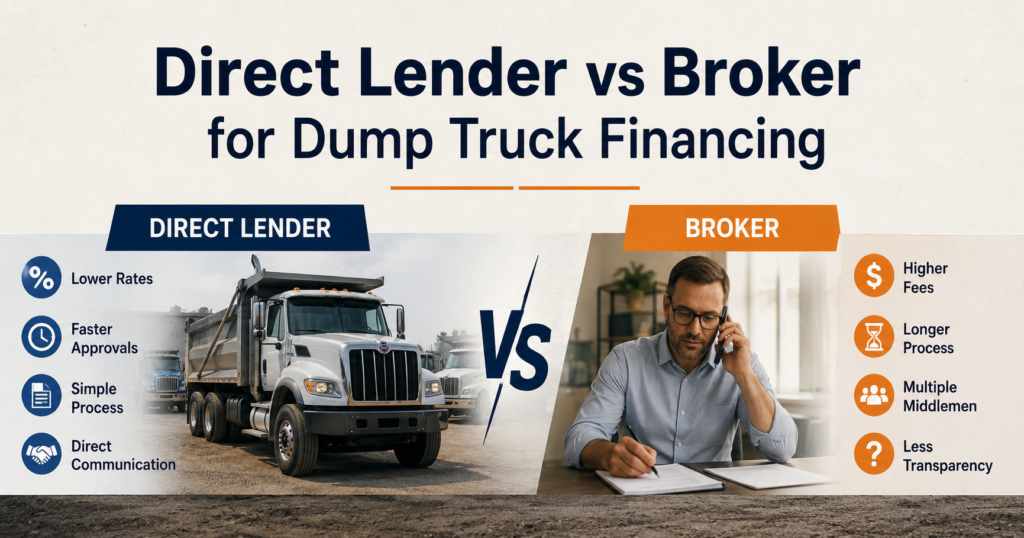
A financing broker generally helps connect borrowers with financing sources. A direct lender provides financing directly and handles its own lending process.
Neither model automatically makes a company right or wrong for every borrower. However, understanding which type of company you are dealing with can help you know who is evaluating your application and who you will be communicating with.
YC Truck Capital identifies itself as a direct, in-house lender. The company states that it underwrites and funds its own loans rather than acting as a broker connecting borrowers with third-party lenders.
For a borrower, this can make it easier to understand who is handling the financing decision and where to direct questions during the process.
6. Support During the Truck-Buying Process
The application itself is only one part of buying a commercial truck.
A financing company should make the process understandable by explaining what information is required and what happens at each stage.
Before applying, ask:
- What documents do I need?
- How do I submit my application?
- What information is required about the truck?
- How will I receive my financing terms?
- Who can answer questions about my application?
- What happens after approval?
YC Truck Capital describes its process as starting with an application, followed by approval, documentation, and funding. Its website also states that lending specialists work directly with applicants rather than through a call center.
Having the truck information and purchase documentation ready can also help make the process more efficient.
7. Reputation and Industry Experience
Before choosing a lender, research the company itself.
Look for:
- How long the company has operated
- Experience with commercial truck financing
- Customer reviews
- Testimonials
- Industry memberships
- Transparency about financing terms
- Clear contact information
- A straightforward application process
Do not rely on a single review or marketing statement. Look at the overall picture and determine whether the lender appears to be a suitable fit for your financing needs.
YC Truck Capital states that its team has more than 25+years of combined experience and identifies itself as a direct lender focused on commercial truck and trailer financing.
What Types of Commercial Trucks Can You Finance?
The types of equipment available for financing depend on the lender, financing program, equipment, and applicant.
Common commercial vehicles that may be eligible for financing include:
Semi Trucks
Semi-truck financing can help owner-operators and trucking companies purchase sleeper trucks and day cabs. Financing may be available for both new and used trucks, subject to the applicable requirements.
Dump Trucks
Dump truck financing can be used by businesses in industries such as construction, excavation, landscaping, demolition, and commercial hauling.
The appropriate financing structure can depend on the truck, purchase price, applicant, and intended business use.
Box Trucks
Box trucks are commonly used by delivery companies, moving businesses, logistics operators, and other commercial businesses.
Financing options may be available for different sizes and configurations, depending on the lender and equipment.
Commercial Trailers
A business may also need to finance a trailer separately from its truck.
Depending on the financing program, commercial trailer financing can include dry vans, refrigerated trailers, flatbeds, utility trailers, car haulers, equipment trailers, and other specialty trailers.
If you already know which truck or trailer you want to purchase, provide the lender with the equipment details when applying. This can help the financing team evaluate the specific transaction.
New vs. Used Truck Financing: What Should You Consider?
Buying new is not automatically better than buying used.
The right choice depends on your business requirements, budget, expected truck usage, and long-term plans.
When comparing new and used commercial trucks, consider:
- Purchase price
- Truck age
- Mileage
- Mechanical condition
- Maintenance history
- Expected operating life
- Warranty coverage
- Financing terms
- Down payment
- Monthly payment
- Expected revenue from the equipment
A used truck may have a lower purchase price, while a newer truck may offer different advantages related to equipment condition, technology, warranty coverage, and expected operating life.
If you choose a used truck, make sure you understand its condition and history before completing the purchase. Financing approval does not replace your responsibility to evaluate whether the equipment is appropriate for your business.
Explore about : Truck Financing for Commercial Trucks
How Much Can You Finance for a Commercial Truck?
There is no single financing amount that applies to every commercial truck buyer.
The amount you may be able to finance can depend on factors such as:
- Truck purchase price
- Truck value
- Down payment
- Credit profile
- Business circumstances
- Equipment type
- Truck age and condition
- Financing term
- Overall transaction structure
For example, two businesses purchasing trucks at the same price may receive different financing options because their financial circumstances or the structure of the transactions are different.
YC Truck Capital states that borrowing amounts depend on factors including credit score, income, down payment, and the value of the truck being financed.
The best way to determine what may be available is to discuss the specific truck and your financing circumstances with a lender.
Why Choose YC Truck Capital for Commercial Truck Financing?
Choosing a financing company is ultimately about finding a lender whose programs and process fit your business.
YC Truck Capital focuses on commercial truck and trailer financing rather than consumer vehicle financing. Its published financing solutions include semi-truck financing, dump truck financing, box truck financing, and trailer financing.
YC Truck Capital also operates as a direct lender, meaning applicants work directly with the company rather than submitting an application through a financing broker to be placed with outside lenders.
For qualifying applicants, YC Truck Capital states that it offers financing for new and used commercial trucks and considers startups and different credit situations through applicable programs. Available terms and approval decisions depend on the specific transaction and underwriting requirements.
The company also offers semi-truck refinancing for qualifying borrowers who want to explore changes to an existing truck financing arrangement. Depending on the circumstances, refinancing may be used to restructure existing debt, change the repayment term, or replace an existing financing arrangement.
Rather than choosing a lender simply because it claims to be the “best,” compare the actual financing options available for your truck, your business, and your financial situation.
Questions to Ask Before Choosing a Truck Financing Company
Before choosing a truck financing company, ask a few key questions about the equipment, financing terms, eligibility, and application process. Clear answers can help you compare lenders and choose an option that fits your business.
What types of trucks do you finance?
Ask whether the lender finances the type of commercial truck or trailer you plan to purchase. Some lenders may have restrictions based on equipment type, age, mileage, or condition.
How much down payment is required?
Down payment requirements can vary based on the lender, truck, and applicant. Ask how much you need upfront and how the down payment affects the amount you will finance.
What loan terms are available?
Ask about available repayment periods and how they affect your monthly payment and total financing cost. A longer term may lower monthly payments but could increase the total interest paid.
What interest rate will I receive?
Ask how the interest rate is determined and whether the quoted rate applies specifically to your application. Compare the actual financing offer rather than relying only on advertised rates.
Are there additional fees?
Ask whether the loan includes application, documentation, origination, or other fees. Knowing the complete cost upfront makes it easier to compare different truck financing options.
Can I finance a used truck?
If you’re purchasing a used commercial truck, confirm that the lender finances used equipment. Ask about any requirements related to the truck’s age, mileage, condition, or value.
What credit requirements apply?
Credit history is one factor lenders may consider when reviewing a commercial truck financing application. Ask whether business history, income, down payment, and truck value are also considered.
Is the company a direct lender or broker?
A direct lender provides financing directly, while a broker generally connects borrowers with financing sources. Knowing which type of company you’re dealing with can help you understand who handles the financing decision.
How long does the financing process take?
Ask about the steps from application to approval and funding, as well as the documents you need to provide. Having your financial and truck information ready can help avoid unnecessary delays.
Can I refinance an existing truck loan?
If you already have commercial truck financing, ask whether the lender offers refinancing. Compare the new terms and total costs with your existing loan before deciding whether refinancing makes sense.
Choose a Truck Financing Company Based on Your Business Needs
The best truck financing company for one business may not be the best choice for another.
Instead of choosing a lender based solely on a headline interest rate, advertised monthly payment, or promise of fast approval, compare the complete financing arrangement.
Look at the lender’s commercial truck experience, equipment eligibility, financing terms, down payment requirements, credit criteria, fees, application process, and customer support.
For owner-operators and trucking businesses, the right financing should work alongside the business rather than simply help purchase a truck.
YC Truck Capital provides direct commercial truck and trailer financing for qualifying applicants across the United States, including financing options for semi trucks, dump trucks, box trucks, and trailers. If you already have a truck in mind, you can submit an application and discuss your financing options with the YC Truck Capital team.